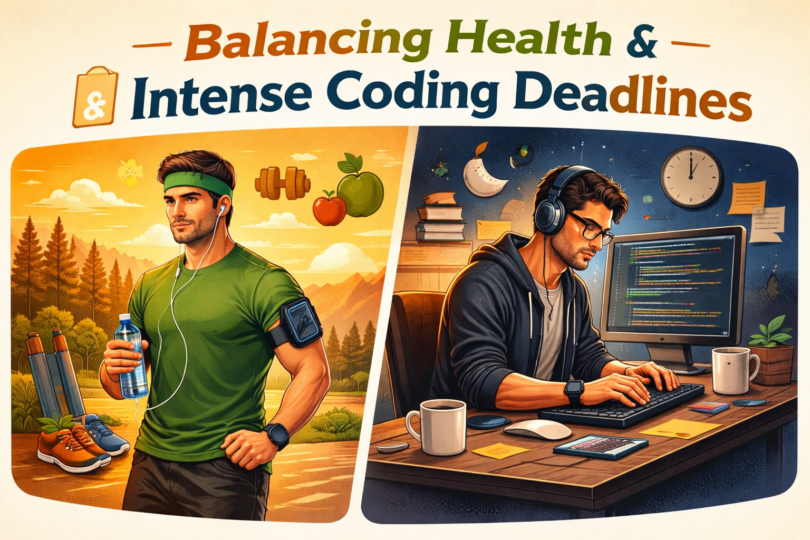

The image of a programmer often involves a dimly lit room, glowing monitors, and a persistent disregard for the circadian rhythm. While the “coding marathon” is often romanticized in tech culture, the biological reality is far less glamorous. For computer science students and professional developers alike, the cognitive demands of syntax and logic often come at a steep physical and mental cost.
As the digital economy grows, the pressure on students to master complex frameworks within tight academic windows has surged. This pressure creates a dangerous friction between academic success and personal well-being. To survive a career in tech—or even just a difficult semester—one must understand the “anatomy” of a healthy coder, moving beyond just writing clean code to maintaining a functional body and a sharp mind.
The Cognitive Burden of Modern Programming
Programming is not merely a task of typing; it is a high-level cognitive process involving abstract problem-solving, mathematical logic, and linguistic precision. When a student sits down to debug a recursive function or architect a database, their brain consumes a significant amount of glucose and oxygen.
The mental fatigue associated with “deep work” is real. When this fatigue sets in, the first thing to suffer is often posture. As the brain focuses intensely on the screen, the body tends to hunch, the neck juts forward (a phenomenon known as “tech neck”), and breathing becomes shallow. Over time, this leads to chronic musculoskeletal issues that can end a career before it truly begins.
For many students, the stress is compounded by the sheer volume of work. When you are staring at a deadline for a compiler design project or a complex web application, the “fight or flight” response kicks in. This elevates cortisol levels, which, when sustained, impairs memory and learning—the very tools a programmer needs most. In these high-pressure scenarios, many students find that the most “healthy” choice is to delegate. Utilizing professional programming assignment help from services like MyAssignmentHelp can act as a vital pressure-release valve, allowing students to reclaim time for sleep and physical recovery without sacrificing their GPAs.
The SQL Syntax Strain: A Case Study in Mental Fatigue
Different programming paradigms affect the brain differently. Procedural languages might require linear logic, while functional programming demands a shift in how one perceives state and data. However, data manipulation languages present a unique kind of mental load.
Consider the complexity of database management. Mastering various sequel programming languages and their specific dialects (like MySQL, PostgreSQL, or T-SQL) requires a dual-track thought process: you must visualize the data architecture while simultaneously ensuring the syntax is optimized for performance.
Because SQL is often used to handle massive datasets, a single misplaced join or a forgotten index can lead to hours of troubleshooting. This “tunnel vision” is where health risks peak. A student might spend six hours straight trying to optimize a query, forgetting to blink, hydrate, or stand up. This leads to Digital Eye Strain (DES), characterized by dryness, blurred vision, and headaches that can persist long after the monitor is turned off.
Physical Foundations: Ergonomics and the 20-20-20 Rule
To mitigate the physical toll of intense coding, a proactive approach to ergonomics is essential. The “Anatomy of a Healthy Coder” starts with the environment.
- The Neutral Spine: Your chair should support the natural curve of your lower back. Your knees should be at a 90-degree angle, and your feet flat on the floor.
- Monitor Placement: The top third of your screen should be at eye level. This prevents the downward tilt of the head that puts up to 60 pounds of pressure on the cervical spine.
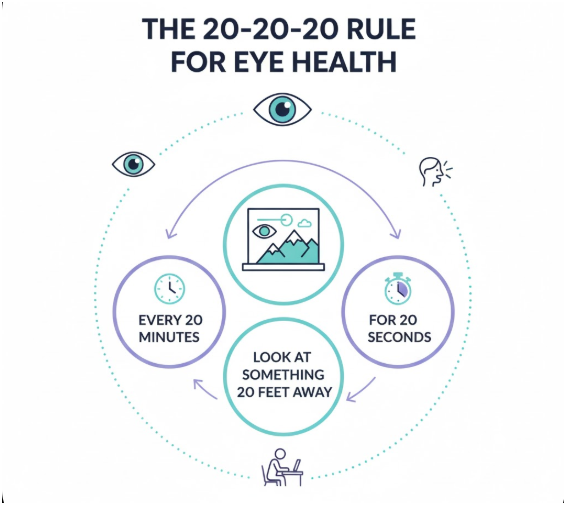
- The 20-20-20 Rule: To combat eye strain, every 20 minutes, look at something 20 feet away for at least 20 seconds. This allows the ciliary muscles in the eye to relax.
Beyond the desk, “micro-movements” are the secret weapon of the healthy developer. Research suggests that standing up for just two minutes every hour can significantly improve blood glucose levels and reduce the risk of cardiovascular issues associated with sedentary behavior.
Nutrition for Neural Performance
What a coder consumes directly impacts their debugging speed. While caffeine is the fuel of the industry, over-reliance leads to “the crash” and increased anxiety.
A brain-healthy diet for programmers should include:
- Omega-3 Fatty Acids: Found in walnuts and flaxseeds, these are essential for maintaining the integrity of brain cell membranes.
- Complex Carbohydrates: Instead of sugary snacks that cause insulin spikes, opt for whole grains. These provide a steady stream of energy to the brain during long coding sessions.
- Hydration: Even mild dehydration can lead to a 10% decrease in cognitive focus. If your code isn’t making sense, drink a glass of water before you try to refactor it.
The Psychological Component: Breaking the “Imposter” Cycle
Perhaps the most overlooked aspect of a coder’s health is their psychological state. The tech industry is rife with “Imposter Syndrome”—the feeling that you aren’t actually qualified and will soon be “found out.” This is especially prevalent among students learning new languages or frameworks.
The stress of feeling inadequate often leads to “over-coding,” where a student stays up all night out of fear rather than necessity. This sleep deprivation further impairs cognitive function, leading to more bugs, which in turn fuels the feeling of inadequacy. It is a vicious cycle.
True health involves recognizing when you are at a point of diminishing returns. Taking a break isn’t a sign of weakness; it’s a strategic move. Stepping away from a problem often allows the “diffuse mode” of thinking to take over, which is where most creative breakthroughs and “Aha!” moments occur.
Conclusion: Sustainability Over Speed
In the world of software development, we often talk about “technical debt”—the cost of choosing an easy, short-term solution now instead of a better approach that takes longer. We must apply this same logic to our bodies. Neglecting your health to meet a programming deadline is simply accumulating “physical debt.” Eventually, the interest will come due in the form of burnout or chronic pain.
About The Author
Hi, I’m Henry Lee, an education consultant and technical writer associated with MyAssignmentHelp. With a background in computer science and a passion for student wellness, I’ve spent the last decade helping students navigate the high-pressure world of academia.