
Introduction — The Technology Behind AI
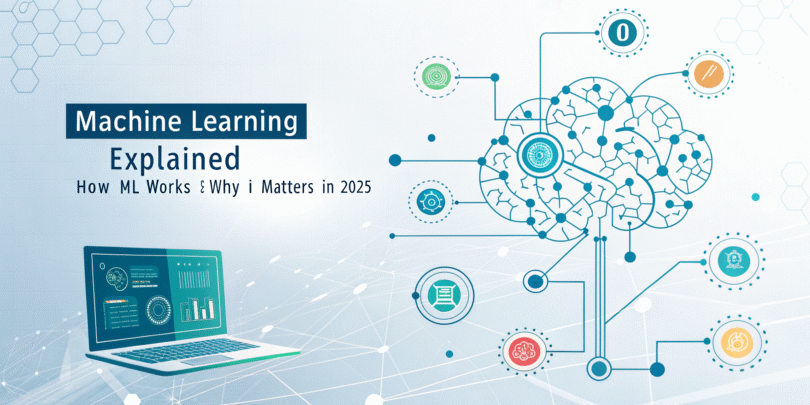
Machine learning explained in simple terms is the easiest way to understand how modern artificial intelligence works in 2025. Many beginners confuse machine learning with artificial intelligence, assuming they are the same thing. In reality, artificial intelligence (AI) is the broader concept of making machines intelligent, while machine learning (ML) is a specific approach used to achieve that intelligence. In simple words, AI is the goal, and machine learning is one of the most powerful tools used to reach that goal.
Today, machine learning is everywhere—often working quietly in the background. When Netflix recommends a movie, when Google completes your search query, when a bank detects fraud, or when a smartphone recognizes your face, machine learning models are making those decisions. These systems don’t rely on fixed rules written by humans; instead, they learn patterns from massive amounts of data and improve their performance over time.
For beginners, this idea can feel overwhelming at first. Terms like algorithms, data, models, and predictions may sound highly technical. However, when machine learning is explained step by step using real-life examples, it becomes much easier to understand. At its core, machine learning is simply about teaching computers how to learn from experience—much like humans do, but at a much larger scale and speed.
But what exactly is machine learning?
This guide explains ML in simple words — no technical background needed.
What Is Machine Learning?
Machine Learning is a branch of AI that enables computers to learn from data without being explicitly programmed.
Instead of writing rules manually, we give the machine:
Data
Examples
Patterns
And the machine learns automatically.
Simple example:
If you show ML many pictures of cats and dogs, it eventually learns to recognize them itself.
How Machine Learning Works (Step-by-Step)
Here’s the simple process:
1. Data Collection
ML starts with data — images, text, numbers, videos.
2. Training the Model
The algorithm analyzes data and learns patterns.
3. Testing
The model is tested using new data to check accuracy.
4. Predictions
Once trained, ML can make predictions like:
“This email is spam.”
“This customer will buy again.”
“This image contains a dog.”
5. Improvement
The model becomes more accurate as more data is added.
Types of Machine Learning
1. Supervised Learning
Learn using labeled data
Example: Spam vs Non-Spam emails
Most common type
2. Unsupervised Learning
No labels
Finds hidden patterns
Example: Customer segmentation
3. Reinforcement Learning
Learn by trial and error
Used in:
Robotics
Gaming
Self-driving cars
Real-World Applications of Machine Learning (2025)
1. Business & Marketing
Customer behavior prediction
Personalized ads
Market trend analysis
2. Healthcare
Disease prediction
Medical imaging
AI diagnosis
3. Finance
Fraud detection
Stock market prediction
Credit scoring
4. Transportation
Traffic prediction
Autonomous driving systems
5. E-Commerce
Product recommendations
Dynamic pricing
6. Cybersecurity
Threat detection
System monitoring
Benefits of Machine Learning
Automates repetitive tasks
Improves accuracy
Saves time and cost
Helps businesses make smarter decisions
Scales easily with more data
Challenges of Machine Learning
Requires large datasets
Can be expensive to train models
Risk of bias in data
Privacy concerns
Needs skilled experts
Future of Machine Learning (2025–2030)
Machine learning will continue to evolve, leading to:
Smarter automation
AI personal assistants
AI-driven businesses
Fully self-driving vehicles
Better medical predictions
Real-time decision-making systems
ML is shaping the future — and those who understand it will stay ahead.
Conclusion
Machine Learning is not just a tech skill — it’s becoming a core part of every industry.
Whether you want to work in AI, boost your business, or understand the future, learning ML basics is the smartest step today.
If you want, I can now generate:
👉 Post 3 for AI & ML
Just say “3”.