
Introduction
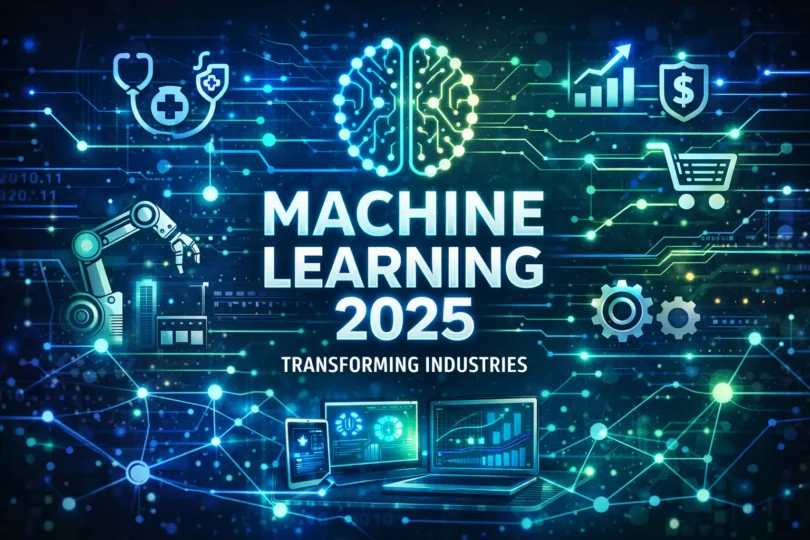
Machine learning 2025 is ushering in a new era of industry transformation. From healthcare to finance, machine learning (ML) is enabling smarter decision-making, automating tasks, and creating personalized experiences for businesses and customers alike. In 2025, machine learning’s applications will reach new heights, revolutionizing how industries operate, optimize, and engage with their audiences.
By leveraging vast amounts of data, machine learning models can generate predictions, automate decision processes, and enhance consumer experiences at an unprecedented scale. In this article, we will explore how ML will reshape various sectors, the challenges and opportunities it presents, and what the future of machine learning holds for industries across the globe.
Table of Contents
- Understanding Machine Learning: What’s New in 2025
- Machine Learning in Healthcare: Predicting Disease and Enhancing Care
- Machine Learning in Retail and E-commerce: Personalizing the Customer Experience
- How ML is Revolutionizing Finance: Improving Security and Risk Management
- Machine Learning in Manufacturing: Improving Efficiency and Reducing Costs
- The Role of ML in Marketing and Advertising: Targeting the Right Audience
- Challenges in Machine Learning Development and Deployment
- The Future of Machine Learning: Trends to Watch
- Conclusion: The Future of Machine Learning and Its Impact on Industries
1. Understanding Machine Learning: What’s New in 2025
Machine learning (ML) has come a long way since its early stages. In 2025, the ML landscape has evolved significantly, driven by advancements in computational power, data availability, and algorithmic innovations. As a subset of artificial intelligence (AI), ML focuses on the development of algorithms that allow machines to learn from data, recognize patterns, and make decisions with minimal human intervention.
Deep Learning Advances
One of the most significant advances in machine learning is deep learning, a form of ML that uses artificial neural networks to simulate the way the human brain works. These models can process vast amounts of data and learn complex patterns. In 2025, deep learning will power everything from speech recognition systems to self-driving cars.
AutoML: Democratizing Machine Learning
Automated machine learning (AutoML) has emerged as a game-changer in the world of machine learning. In 2025, it allows even those with limited data science experience to develop and deploy ML models. By automating the process of selecting algorithms, feature engineering, and model optimization, AutoML is democratizing access to machine learning and making it easier for businesses to implement ML solutions.
2. Machine Learning in Healthcare: Predicting Disease and Enhancing Care
Machine learning is transforming healthcare, improving diagnoses, treatment plans, and patient outcomes. With AI models capable of analyzing medical data more accurately than ever before, healthcare professionals can provide better care, faster.
Predicting Diseases with Precision
In 2025, machine learning will play a central role in predicting diseases such as cancer, diabetes, and cardiovascular conditions. ML models can analyze vast amounts of medical data, including patient history, genetic information, and imaging scans, to predict potential health risks and offer early detection.
For example, ML is already being used to predict the likelihood of developing conditions like Alzheimer’s disease by analyzing brain scans. In 2025, we will see more widespread use of such predictive tools, allowing healthcare providers to catch diseases earlier and implement preventive measures.
Medical Imaging and Diagnostics
Machine learning has already begun to revolutionize the field of medical imaging. In 2025, AI-driven tools will assist radiologists in detecting abnormalities such as tumors, fractures, and organ damage with greater accuracy and speed. By automating the analysis of medical images, ML reduces human error and ensures faster, more reliable diagnoses.
Personalized Medicine and Treatment Plans
Machine learning in healthcare will also enable highly personalized treatment plans. ML models can analyze individual patient data to recommend tailored treatments, ensuring that each patient receives the most effective care. In 2025, we can expect ML-powered tools to be increasingly used to design individualized drug regimens and therapy plans based on genetic profiles and medical histories.
3. Machine Learning in Retail and E-commerce: Personalizing the Customer Experience
Machine learning is already playing a significant role in e-commerce and retail, enabling companies to offer highly personalized customer experiences. In 2025, we will see further advancements in this space, making shopping experiences smarter, more intuitive, and more engaging.
Personalized Recommendations
One of the key applications of ML in e-commerce is personalized product recommendations. By analyzing user behavior, preferences, and purchase history, ML algorithms can suggest products that a customer is likely to be interested in, increasing sales and customer satisfaction. In 2025, the accuracy and relevance of these recommendations will improve significantly, thanks to advancements in deep learning.
Dynamic Pricing Models
Machine learning is also being used to implement dynamic pricing models in retail. These models use real-time data, including competitor prices, demand fluctuations, and customer sentiment, to adjust prices dynamically. In 2025, this approach will be more refined, allowing retailers to optimize pricing strategies based on a variety of factors, maximizing profitability while remaining competitive.
Chatbots and Virtual Assistants
ML-powered chatbots and virtual assistants are revolutionizing customer service in retail. These AI-driven tools can understand natural language, assist customers in finding products, and even handle transactions. In 2025, chatbots will become even more advanced, capable of handling more complex customer queries and offering a seamless shopping experience.
4. How ML is Revolutionizing Finance: Improving Security and Risk Management
Machine learning is increasingly being used in the financial sector, enhancing decision-making, fraud detection, and risk management. In 2025, machine learning models will help financial institutions process large amounts of data in real-time to optimize investments, predict market trends, and safeguard against fraud.
Fraud Detection and Prevention
One of the most critical applications of machine learning in finance is fraud detection. ML algorithms can analyze transaction data in real-time, identifying anomalies that may indicate fraudulent activity. In 2025, financial institutions will rely even more heavily on machine learning to detect fraud and mitigate risks associated with online transactions.
Credit Scoring and Risk Assessment
Machine learning models are also being used to assess credit risk. By analyzing historical data, financial behavior, and transaction patterns, ML models can predict a person’s likelihood of repaying a loan. This approach allows for more accurate and personalized credit scoring, enabling banks to lend more responsibly.
Algorithmic Trading
Machine learning is transforming the world of trading, with algorithms capable of analyzing vast amounts of market data to make buy and sell decisions. In 2025, ML-powered trading bots will become more sophisticated, capable of making high-frequency trades and predicting market movements with greater precision.
5. Machine Learning in Manufacturing: Improving Efficiency and Reducing Costs
Machine learning is revolutionizing manufacturing by enhancing automation, improving efficiency, and reducing costs. In 2025, we can expect to see even more ML-driven innovations in production lines, predictive maintenance, and quality control.
Predictive Maintenance
ML models can predict when equipment will fail, allowing manufacturers to perform maintenance before a breakdown occurs. This predictive maintenance reduces downtime and saves money on emergency repairs. In 2025, more manufacturers will adopt these technologies to ensure their operations run smoothly and efficiently.
Quality Control and Automation
Machine learning is already being used to automate quality control in manufacturing. By analyzing images of products during the production process, ML algorithms can detect defects and ensure that only high-quality products are shipped. This technology will become more widespread in 2025, helping manufacturers reduce waste and improve the overall quality of their products.
Supply Chain Optimization
Machine learning is helping manufacturers optimize their supply chains by analyzing data on inventory levels, shipping times, and supplier performance. In 2025, ML models will enable more efficient supply chain management, allowing manufacturers to anticipate demand, reduce stockouts, and lower operational costs.
6. The Role of ML in Marketing and Advertising: Targeting the Right Audience
Machine learning is transforming marketing and advertising by enabling businesses to target their audience more accurately and personalize their campaigns.
Customer Segmentation and Targeting
ML algorithms can analyze customer behavior and segment audiences into distinct groups based on preferences, demographics, and purchasing patterns. This allows businesses to target specific groups with highly personalized ads and offers. In 2025, marketing campaigns will become even more tailored, thanks to advancements in machine learning.
Ad Optimization
Machine learning is also improving ad targeting by analyzing which ads perform best with which audiences. By automatically adjusting targeting parameters in real-time, ML algorithms can optimize ad placements, ensuring maximum return on investment for advertisers.
7. Challenges in Machine Learning Development and Deployment
While machine learning offers tremendous potential, it also comes with challenges that need to be addressed.
Data Quality
High-quality data is essential for training effective ML models. Poor data quality can lead to inaccurate predictions and suboptimal results. In 2025, businesses will need to focus on data quality and ensure that their datasets are clean, accurate, and representative of the problem they are trying to solve.
Model Bias
ML models can unintentionally perpetuate biases if they are trained on biased data. This can lead to unfair or discriminatory outcomes, particularly in areas like hiring, lending, and law enforcement. In 2025, addressing model bias will be critical to ensuring that machine learning systems are ethical and fair.
Scalability and Deployment
Deploying ML models at scale can be challenging. Businesses will need to ensure that their infrastructure can handle the computational requirements of ML models and that they can deploy models efficiently in real-world environments.
8. The Future of Machine Learning: Trends to Watch
As machine learning continues to evolve, several trends are likely to shape its future in 2025 and beyond.
Explainable AI (XAI)
In 2025, there will be a growing emphasis on explainable AI, which focuses on creating models that can explain their decision-making processes. This will help build trust in ML systems, particularly in sectors like healthcare and finance, where decisions need to be transparent.
Federated Learning
Federated learning is a decentralized approach to machine learning where data is kept on local devices, and only model updates are shared. This technology ensures privacy while allowing machine learning models to be trained on distributed data. In 2025, federated learning will become more widely adopted.
9. Conclusion: The Future of Machine Learning and Its Impact on Industries
Machine learning is already revolutionizing industries, and in 2025, its impact will be even more pronounced. From healthcare to finance and retail, ML is transforming how businesses operate, engage with customers, and optimize their processes. While challenges remain, the future of machine learning looks promising, with innovations that will continue to shape industries and create new opportunities.
By embracing machine learning technologies, businesses can stay ahead of the curve and ensure that they are prepared for the future. As ML becomes more accessible and its applications expand, we can expect to see even greater efficiencies, smarter decisions, and enhanced experiences for customers worldwide.