
Introduction
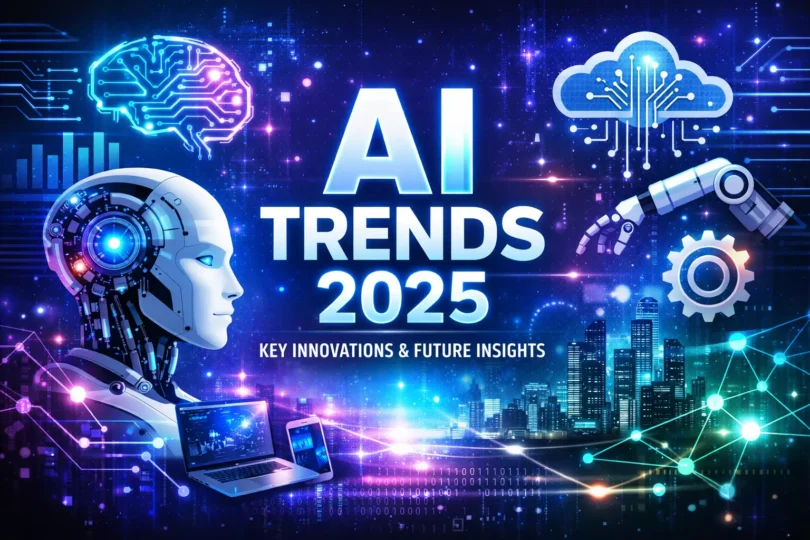
AI trends 2025 show a significant shift in how industries are adopting AI technologies. From automation to healthcare, AI is rapidly transforming the way we work and live. In this article, we’ll explore the key trends shaping AI’s future, from AI democratization to its role in driving smart automation and personalized experiences.
- Key Trends Driving AI in 2025
- AI democratization: How AI tools are becoming more accessible to businesses of all sizes, enabling faster and cheaper development of AI-based solutions.
- AI-powered automation: Industries adopting AI for automating tedious tasks like customer service (chatbots, virtual assistants) and logistics management.
- AI integration with IoT: The synergy between AI and Internet of Things (IoT) devices for smarter decision-making.
- AI in Healthcare: Revolutionizing Diagnosis and Treatment
- AI-powered diagnostics: The role of AI in early disease detection, such as detecting cancers or predicting genetic disorders using imaging.
- Robotic surgery: AI-powered robots that assist doctors in performing precise surgeries with minimal human intervention.
- Personalized medicine: How AI analyzes patient data to create personalized treatment plans and predict outcomes.
- How AI is Reshaping Financial Services
- Fraud detection: AI’s role in monitoring transactions and identifying fraudulent activities in real-time.
- AI-driven financial advising: How AI is helping consumers make investment decisions by analyzing vast amounts of financial data.
- Automated trading: The rise of AI in high-frequency trading and stock market analysis.
- Automation and AI in Manufacturing: The Next Leap
- Predictive maintenance: AI’s ability to predict when machinery will fail, saving money and preventing downtime.
- AI-powered robots: Robots that are increasingly autonomous, performing tasks like assembly, packing, and quality control.
- Supply chain optimization: How AI improves logistics and supply chain management, enabling smarter decisions.
- AI and Ethics: The Challenges Ahead
- Bias in AI models: How AI systems can unintentionally perpetuate societal biases if not properly trained.
- Data privacy concerns: The importance of secure and private data handling in AI applications, particularly in sectors like healthcare and finance.
- Regulation: The need for clear guidelines and regulations to ensure the responsible use of AI technology.
- The Role of AI in Personal Assistants and Consumer Devices
- AI-powered smart assistants: How assistants like Siri, Alexa, and Google Assistant are improving through natural language processing and contextual awareness.
- Smart homes: AI’s role in managing home automation, including security, temperature control, and energy management.
- Real-World Use Cases of AI in 2025
- Autonomous vehicles: How AI is powering self-driving cars, making transportation safer and more efficient.
- Smart cities: AI used in city planning, traffic management, and crime detection.
- The Future of AI: Predictions and Challenges
- AI-enhanced creativity: The role AI will play in the arts, from generating music to assisting in movie production.
- Human-AI collaboration: AI working alongside humans to augment decision-making in complex scenarios.
Conclusion
The future of AI in 2025 is incredibly promising, with advancements that will continue to revolutionize industries. By embracing AI technologies, businesses and individuals alike can unlock new opportunities while navigating challenges in ethics, regulation, and human-AI collaboration.