
Introduction
AI vs Machine artificial intelligence, it’s completely normal to feel confused by terms like AI, machine learning, and deep learning. These phrases are often used interchangeably in articles, job posts, and tech discussions, even though they don’t mean the same thing.
Understanding the difference between AI, machine learning, and deep learning is important because each one plays a unique role in how modern technology works. From recommendation systems and chatbots to facial recognition and self-driving cars, these technologies are connected—but not identical.
In this guide, we’ll clearly explain AI vs machine learning vs deep learning using simple language, real-world examples, and practical comparisons so you can confidently understand how they fit together.
Internal link: What Is Artificial Intelligence? A Complete Beginner Guide
What Is Artificial Intelligence AI vs Machine?
Artificial Intelligence is the broad concept of machines designed to perform tasks that typically require human intelligence. These tasks include reasoning, learning, problem-solving, understanding language, and decision-making.
AI is not a single technology—it’s an umbrella term that includes many approaches and techniques.
Examples of AI
Voice assistants like Siri and Alexa
Chatbots on websites
Image recognition systems
Recommendation engines
Internal link: Machine Learning Explained — How ML Works & Why It Matters
What Is Machine Learning (ML)?
Machine learning is a subset of artificial intelligence that focuses on enabling machines to learn from data instead of being manually programmed.
Instead of following fixed rules, machine learning systems improve automatically by analyzing patterns in data.
Common Machine Learning Examples
Email spam filters
Product recommendations
Fraud detection systems
Search engine rankings
Key idea:
All machine learning is AI, but not all AI is machine learning.
What Is Deep Learning?
Deep learning is a specialized subset of machine learning that uses neural networks with multiple layers (called deep neural networks).
Deep learning excels at handling large amounts of unstructured data like images, audio, and video.
Deep Learning Examples
Facial recognition
Speech-to-text systems
Self-driving car vision
Medical image analysis
Internal link: Deep Learning Explained for Beginners — How Neural Networks Work
Key Differences Between AI, ML, and Deep Learning
Comparison Table
FeatureArtificial IntelligenceMachine LearningDeep LearningScopeBroad conceptSubset of AISubset of MLData DependencyLow–HighHighVery HighComplexityLow–HighMediumHighHuman InterventionHighMediumLowExamplesChatbotsSpam filtersFacial recognition
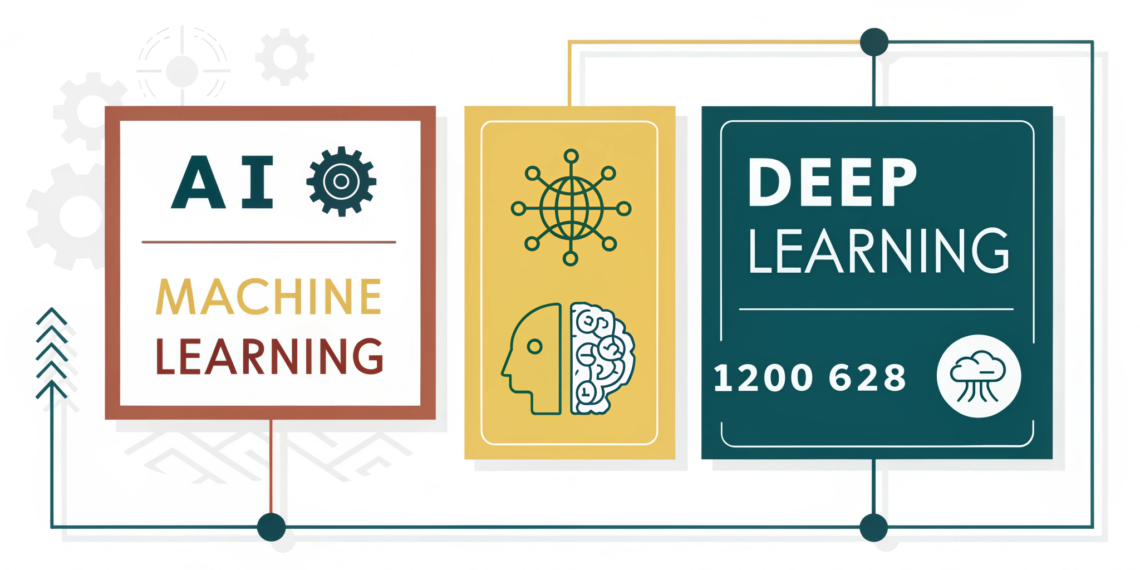
How AI, ML, and Deep Learning Work Together
Think of these technologies as layers:
AI is the goal (smart machines)
Machine Learning is one way to achieve AI
Deep Learning is an advanced ML technique
Real-World Example
A voice assistant:
Uses AI to understand and respond
Uses ML to improve accuracy
Uses Deep Learning for speech recognition
Real-World Use Cases Compared
E-Commerce
AI: Personalized shopping experience
ML: Product recommendations
Deep Learning: Visual search
Healthcare
AI: Smart diagnosis systems
ML: Predictive analytics
Deep Learning: Medical image detection
Transportation
AI: Route optimization
ML: Traffic prediction
Deep Learning: Object detection in self-driving cars
Common Beginner Confusions & Mistakes
Mistake 1: Using the terms interchangeably
Each term has a specific meaning and scope.
Mistake 2: Thinking deep learning is always better
Deep learning requires large datasets and high computing power.
Mistake 3: Assuming AI replaces humans
AI systems still need human oversight and decision-making.
Which One Should You Learn First?
Beginner Path Recommendation:
Start with Artificial Intelligence basics
Learn Machine Learning fundamentals
Move to Deep Learning if needed
Practical Tip:
If you’re not from a technical background, focus on AI concepts and applications before diving into coding-heavy topics.
Future of AI, ML, and Deep Learning
These technologies will continue to evolve together:
AI will become more integrated into daily life
ML models will become easier to build
Deep learning will power advanced automation
However, ethical use, data quality, and transparency will remain critical.
Internal link: Future of Artificial Intelligence — Trends & Opportunities
FAQ Section
What is the main difference between AI and machine learning?
AI is the broader concept of intelligent machines, while machine learning is a method that allows machines to learn from data.
Is deep learning better than machine learning?
Not always. Deep learning is powerful but requires large datasets and resources.
Can AI work without machine learning?
Yes. Some AI systems use rule-based logic instead of learning from data.
Do beginners need deep learning?
No. Beginners should start with AI and ML basics first.
Where are AI, ML, and deep learning used? They are used in healthcare, finance, e-commerce, entertainment, and transportation
Internal Linking Summary
→ What Is Artificial Intelligence
→ Machine Learning Explained
→ Deep Learning Explained
→ Future of Artificial Intelligence
External Links
Google AI Blog
IBM AI & ML Documentation
OpenAI Research